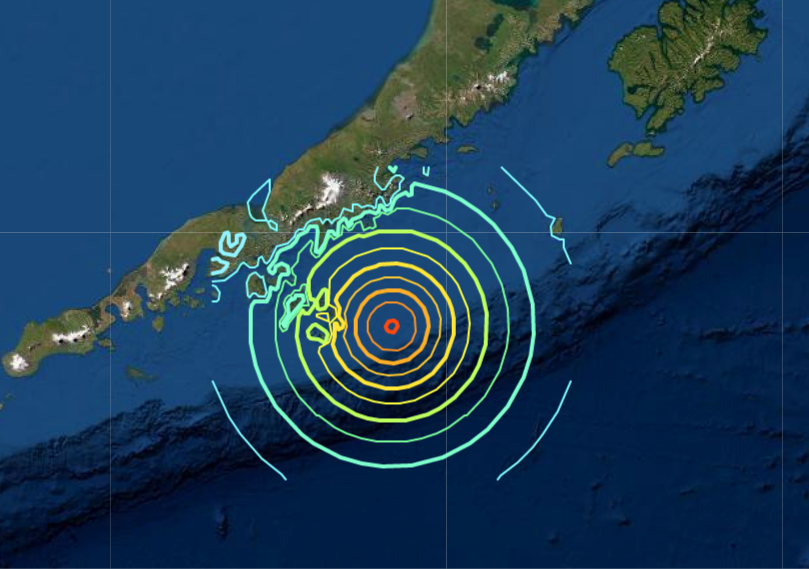
On July 15, 2023, the offshore region of the Alaska Peninsula was rocked by a significant seismic event. A powerful 7.2 magnitude earthquake erupted, rekindling memories of the 7.8 Simeonof earthquake from nearly three years prior. Situated 50 miles south of Sand Point, the epicenter was roughly 100 miles southeast of the previous Simeonof event. This latest seismic shockwave has again highlighted the volatility of this geologically active region.
Upon the earthquake's occurrence, an immediate tsunami warning was declared, with coastal communities being urged to evacuate to higher ground. The warning was downgraded to an advisory within an hour and was eventually lifted entirely before 1:00 a.m. Maximum recorded tsunami waves of half a foot were reported in King Cove and Sand Point.
Residents from a multitude of communities located on the Alaska Peninsula and the eastern Aleutian Islands reported experiencing substantial ground shaking. The shaking intensity was rated as high as V, suggesting moderate tremors and the potential for light damage to buildings and other structures.
Notably, the July 15 event took place within the aftershock zone of the 7.8 Simeonof quake. While aftershock activity from the 2022 event has considerably declined, the region continues to experience higher than average seismic activity. Consequently, it can be interpreted that the latest 7.2 earthquake is a late aftershock of the previous larger event.
The geological mechanism of this quake is similar to that of the Simeonof event, suggesting a rupture along the infamous Aleutian megathrust fault. Predictably, this 7.2 quake has already begun to generate its own aftershock sequence, as evidenced by a magnitude 5.0 tremor occurring merely three minutes after the main event.
Looking back, on July 29, 2022, an even larger magnitude 8.2 earthquake occurred northeast of the Simeonof Earthquake epicenter. That event's rupture propagated northeast, away from the aftershock zone of the earlier quake.
With the occurrence of the 7.2 magnitude event on July 15, 2023, we've seen yet another major seismic event in the span of three years. These events have effectively ruptured the subduction zone interface from the Shumagin Islands in the southwest to Kodiak Island in the northeast. The Shumagin Islands region was once known as a seismic gap, where significant seismic events had not recently occurred. However, this recent sequence of events has partially filled this gap, providing valuable data for further scientific analysis.
In conclusion, the series of recent seismic events in the Shumagin Islands region highlight the dynamic and unpredictable nature of Earth's geological processes. The immediate aftermath has again shown the importance of being prepared and having effective emergency response measures in place for such natural disasters.
Comments
Post a Comment